
Kicking Off the Year: CBDIO’s Outreach Efforts and Celebrated Achievements
- May 29
- 21 min read
Monthly Newsletter - December 2025-January 2026
Immigration: From Limitation to Success
By Edith Rojas and Gregorio Matiaz

Fresno, CA - During the month of January, we successfully guided a 28-year-old community member with intellectual disability navigate through the complex naturalization application process. This young man was unable to make decisions for himself, so he was totally dependent on his mother to navigate the complexities of everyday life, including the process of applying for citizenship. For him, the path to naturalization became significantly more complicated because he needed a medical exception certification due to his intellectual disability diagnosis. Because of this he could not take the oath of allegiance for himself and needed his U.S. citizen sibling to be present during the interview. This was a challenge, because his brother lives in another state and needed to travel. When the day arrived, his brother could not accompany him because of flight cancellations. Fortunately, his mother was able to accompany him and took the oath of allegiance on his behalf.
The citizenship process is difficult for anyone, but for people with intellectual disabilities and their caregivers, it can be overwhelming and inaccessible without the help of experts. This case shows us that disability is not an obstacle to citizenship and full participation in our community. For this young man, citizenship means access to federal benefits, protection from deportation and the dignity of being a full member of the only country he calls home.
We would also like to congratulate five more members of our community who have recently become citizens.
Healthcare Coverage for Farmworkers
By Lidia Reyes and Teresa Morales

Madera, CA - During the open enrollment period for the Kaiser Permanente Community Health Care Program, the CBDIO Kaiser team reached the immigrant community strategically, adjusting their hours to work in the evenings and weekends so that farmworkers could come to the CBDIO offices and apply for the program in hopes to obtaining access to health care coverage.The program is available to the community regardless of immigration status or age. The program is a great alternative to the community that does not have any other options for health care coverage through employer insurance, Medi-Cal, Medi-Care, or Covered California. During the open enrollment from November 1, 2026 to January 13, 2026, 91 people successfully enrolled and gained access to free medical coverage. With all the changes already affecting the community and upcoming changes to the Medi-Cal program, this healthcare option is extremely important.
Behind each application were stories of undiagnosed illnesses, delayed pain, and medical care that had been inaccessible due to immigration status. Farmworkers often postpone doctor visits for serious medical conditions because they lack access to health insurance. Today, thanks to this program, these community members are receiving care for conditions such as cancer, diabetes, and heart disease, among others transforming uncertainty into care, relief, and hope.
Connecting Health and Community through the Fresno County Health Disparities Program
By Anayeli Pacheco and Ana Arenas

Fresno, CA - The Fresno Health Disparities team receives referrals from the Fresno County Department of Public Health to support community members facing extraordinary health barriers and need assistance of a community health worker to navigate available resources. Some of these individuals have been hospitalized, have faced quarantine for health reasons, or require additional support.
CBDIO's community health workers provide resources, information, and education to the community. Our health team has received referrals for individuals who speak an Indigenous language and require support from someone who can assist them in their native tongue, Some cases are referred by the Fresno Department of Public Health's tuberculosis team. Our team provides education about diseases and connects individuals to other beneficial resources. Upon entering the CBDIO health program, a needs assessment is conducted, exploring areas where support is required. The assessment focuses on areas of need such as access to housing, transportation, healthcare, personal safety, childcare, and family planning. Most community members referred to us have experienced difficulty obtaining health insurance, food insecurity, scheduling medical appointments, reading and completing applications for public assistance programs like CalFresh and CalWORKs, and accessing financial assistance. Our team strives to provide information, support, and guidance to help individuals meet their needs. Even though there are barriers for in-person support.
Celebration of achievements with the Chatino and Mixtec Committees 2025 in Salinas, California
By Maricela Ramírez— Economic Justice Program Coordinator

Salinas, CA - On December 19, 2025, the Chatino and Mixteco Committees celebrated with joy and pride the achievements of the year. More than 40 community leaders, accompanied by their children, gathered in a space of sharing to recognize and give thanks for the collective effort that made these important advances possible in Monterey County.
During the celebration, stories, reflections, and achievements were shared that demonstrated the community's great commitment, unity, and perseverance. It was a moment to recognize that each step taken was the result of constant work, organization, and the courage to raise their voices in different decision-making spaces.
One of the most significant achievements of the year was the establishment of a pilot program at the Alisal Clinic, a historic victory driven by the strong and persistent advocacy of the Mixteca and Chatina community. Thanks to this collective effort, it was achieved and is continuing to be established at the Alisal Clinic in Salinas:
Hire community workers who speak Indigenous languages at the clinic.
Educate clinics about Indigenous communities.
Create an indigenous community committee.
Document the language of the Indigenous community.
Share documents and information in Indigenous languages.
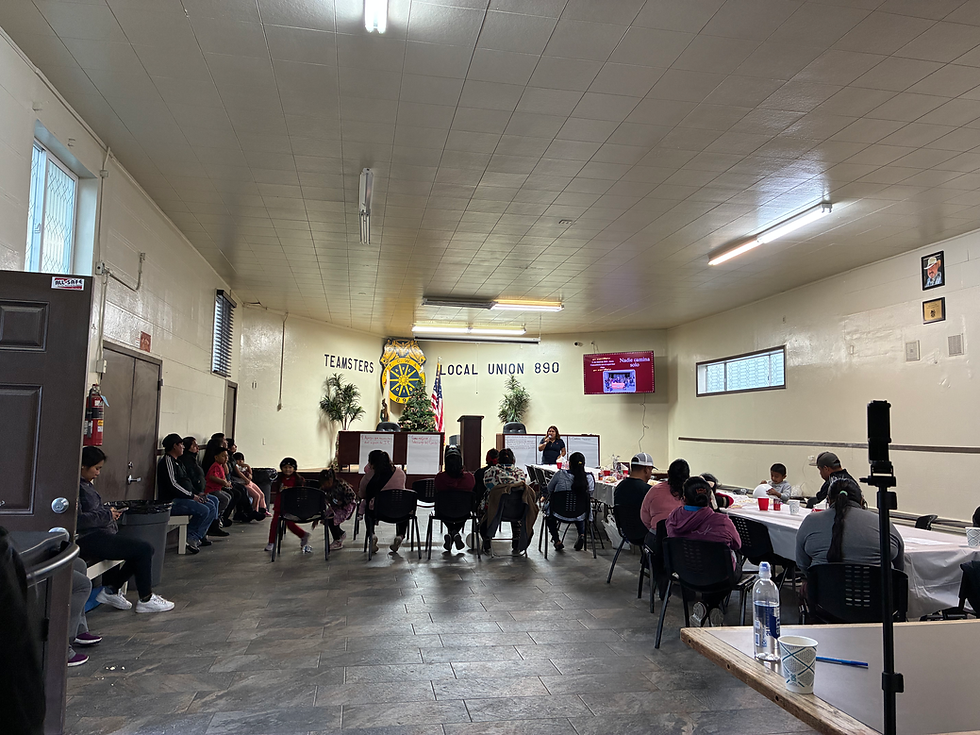
For months, the community actively participated in various decision-making spaces, defending their priorities and demanding dignified, respectful, and inclusive treatment. The community's voice was key to highlighting the barriers they face and demanding changes in systems that historically have not been created with indigenous people in mind.
This celebration not only marked the achievements made, but also reaffirmed the power of community organization and the hope of continuing to build a more just, inclusive, and dignified future.
Celebrating achievements with the Labor Justice team and community outreach in Salinas, CA
By Jissel Antonio and Yesica Guzman, Labor Justice Team

Salinas, CA - During the month of January, the Monterey County Labor Justice Team held our first celebration of achievements with farmworkers. Twenty-two people from the community attended the event with their families. We shared a presentation on the year's achievements and pozole was prepared by a member of the Mixteco community. The community gathered and celebrated. One of our achievements was the recovery of $11,956.49 for workers in stolen wages. Through our outreach efforts during the year, we reached a total of 3,550 people in Monterey County and in the city of Watsonville. The way in which the voice of workers has influenced the work of CBDIO was also highlighted. It was the team's first celebration and it was very important to recognize the leadership of workers, their collective work, and continuing to empower our community. We closed the night enjoying pozole, listening to Mixtec chilenas, and dancing.
The Labor Justice team also started the year with a strong outreach and presence in the community, reaching 522 people through outreach in the streets, door-to-door visits, and food distributions. We provided information about labor rights and invited the community to the labor rights clinic that we will hold on February 6 alongsideLabor Commissioner's office and other state agencies at Bardin Elementary School. Something that greatly supported our outreach activities is having a new colleague from the Chatino community. His support is very important in building trust and improving our outreach to the Chatino community.
Harvesting Profits, Stealing Wages
By Amalia Bernardo and the Labor Justice Team

In January 2026, the Labor Justice team in the Central Valley and Central Coast supported workers in recovering $53,141.55 in stolen wages. Through the wage theft cases received, we saw a troubling pattern: farmworkers were underpaid or not paid at all for their labor.
In one case, more than ten workers who worked in the rolling of raisins for an employer in Caruthers were earning as little as $43.24 for a 10-hour shift. They went directly to their employer and demanded payment of their stolen wages, including waiting time penalties, as well as proper pay stubs. The employer refused. As a result, the workers filed a claim with the Labor Commissioner’s Office. Unfortunately, this is not an isolated incident. We regularly hear from workers whose employers knowingly pay them below the minimum wage. Of the many wage theft cases the Labor Justice team supported in 2026, not all workers were able to recover their stolen wages. Many are still now waiting for the Labor Commissioner’s Office to investigate their wage claims, a process that can take one to three years.
While it is a significant achievement to have supported workers in recovering $53,141.55 in stolen wages in 2026, it is deeply troubling to see wage theft become so common throughout the Central Valley and Central Coast. Farmworkers deserve stronger protections and most importantly, those protections must be enforced. They deserve to be paid more than just the minimum wage. The very people who carried the agricultural industry through the COVID-19 pandemic should not be struggling to pay rent and support their families. Until there is a change in the system, employers including farm labor contractors and growers will continue to exploit farmworkers and evade accountability.
Mothers Talking and Healing
By Nicolasa Rodriguez and Alejandra Campos

Greenfield, CA - During the month of December, the Mamás Platicando y Sanando program sessions in Triqui and Mixteco were successfully completed. Many mothers expressed that thanks to the sessions, they learned to recognize their emotions, understand mixed feelings, and acquire tools to better manage these feelings. At the beginning, several were reserved and shy talking about their feelings, but over time they were able to share their experiences with greater confidence.
A new mother from the Triqui community was invited by her sister to participate in the sessions because she had experienced symptoms of depression and suicidal thoughts during her first pregnancy, while she was still living in her hometown. She shared that she had never received information about mental health and did not feel confident asking for help due to fear of being judged. Through her participation in the program, she learned that what she was experiencing was not normal and that she could ask for support without feeling shame. She also learned about tools on how to manage her emotional health and express her needs. As a result, she is currently receiving counseling during her pregnancy and actively participating in the mothers’ sessions, where she feels encouraged and supported by other women from her community.
In addition, she applied what she learned by advocating for her well-being during her medical appointments. With the support of a facilitator, she requested an interpreter in her language, Triqui, which allowed her to receive better medical care. She now feels calmer and more confident during her visits with the doctor. The Mamás Platicando y Sanando program has, overall, greatly benefited Indigenous mothers.
One special case this year is that of a first-time mother from the Mixteco community. She deeply desired to have a baby and eventually became pregnant. However, after a few months of pregnancy, everything changed for her—her mood and emotions shifted, she no longer wanted to go out, and she felt ashamed of her pregnancy without understanding why she felt that way. After her baby was born, she no longer had time for herself; her baby cried frequently and became ill often. She began to believe it was her fault and thought she was a bad mother. One day, while she went out for a walk, community health workers from CBDIO invited her to participate in the Mamas Platicando y Sanando sessions. At first, she did not believe the sessions would help her, but one day she decided to give them a try. Although she initially lacked confidence, after attending several sessions she began to feel comfortable sharing her emotions within the group. She has mentioned that she has improved significantly and that her emotional state has changed. Even her husband has noticed the change, and at times has accompanied her to the CBDIO office, waiting in the lobby while she participates in the mothers’ sessions.
McKinnon Elementary School - VeꞋe TùꞋun program at McKinnon
By Daniela Maldonado

Salinas, CA - December was a month filled with joy, and students began the month with great enthusiasm. They were eager for time to pass quickly, as they excitedly awaited winter break, which lasted three weeks. Before leaving for vacation, the VeꞋe TùꞋun Program team at McKinnon Elementary School shared unforgettable moments with the students. Together, they made piñatas, which were later filled with Mexican candy. Each student received a small Christmas gift and listened to Christmas music. Students also shared conversations about the trips and activities they were planning to do with their families.

Students returned to their routine on January 13. During this month, the main focus was on providing additional academic support. Instructors Esilena and Daniela have spent time with the students and identified that many students experience challenges in mathematics, reading, and writing. Cultural and language lessons in Mixteco were always included. During these past months, students learned topics such as numbers from 1 to 25, parts of the body in Mixteco, basic verbs, and names of animals, among other words. At the end of January, an after-school intervention was implemented at McKinnon Elementary School to provide additional support to students. Ten students who participate in our program are part of the Expanded Learning Opportunities Program intervention and attend one hour per day, Monday through Thursday.
VeꞋe TùꞋun After-School Program – Santa Rita Elementary¡A Year-End Filled with Learning, Culture, and Community!
By Leonardo Gálvez
Salinas, CA - During the month of December, the VeꞋe TùꞋun After-School Program experienced a meaningful time of reflection, community, and celebration.
Since the beginning of the month, instructors worked with students on the creation of decorative piñatas to celebrate the winter season. This activity encouraged participation and helped develop creativity, coordination, teamwork, patience, and mutual support.
On December 15, a parent meeting was held at Santa Rita Elementary School to share information about the program, its goals, and student activities.
During the first week of January, students were on winter break and returned to classes on January 13. Prior to their return, part-time instructors prepared Mixtec language materials to begin the new year in an organized manner.
Once activities resumed, students participated in readjustment and group-building activities. Topics covered during the month included body parts, animals native to Mesoamerica, and family, integrating the Mixtec language through vocabulary practice, games, and group activities. In addition, the program team provided interpretation support for parents present at the school, helping facilitate communication with school staff.
Updates
IMMIGRATION
By Edith Rojas and Gregorio Matiaz
We would like to share some of the new laws that have gone into effect in the state of California since January 1, 2026:
Identification of agents (SB 627): Local and federal law enforcement officers, including ICE, are prohibited from wearing masks or other facial coverings while on immigration operations. This measure seeks to increase transparency, accountability, and public trust during arrests, protests, or, specifically, federal immigration raids. A U.S District Court has blocked the implementation of this law.
Family Preparedness Act (AB 495): Allows immigrant parents to legally appoint temporary guardians for their children in the event of detention or deportation, allowing parents to name friends or mentors, not just relatives.

Educational Equity and Protection of Immigrant Families (AB 419): Protects students and their families from the collection of information about their immigration status by schools. It also requires schools to post information about student rights in immigration enforcement on administrative offices and school websites.
Statewide Reach

*Español
Inicio del Año: Actividades de Alcance y Logros Destacados
Boletín mensual - Diciembre 2025-Enero 2026
Inmigracion: De la limitación al éxito
Escrito por Edith Rojas y Gregorio Matiaz
Fresno, CA - Durante este mes, ayudamos con éxito a un miembro de la comunidad de 28 años con discapacidad intelectual a navegar por el complejo proceso de solicitud de naturalización. Este joven no es capaz de tomar decisiones de forma independiente, por lo que dependía totalmente de su madre para desenvolverse en las complejidades de la vida cotidiana, incluido el proceso de solicitud de la ciudadanía. El camino hacia su naturalización se complicó considerablemente, ya que necesitaba un certificado de exención médica debido a su diagnóstico de discapacidad intelectual. Por este motivo, no pudo tomar el juramento de lealtad y necesitó que su hermano, ciudadano estadounidense, estuviera presente durante la entrevista. Esto representó un reto, porque su hermano vive en otro estado y tenía que viajar. Llegado el día su hermano no pudo acompañarlo porque se canceló su vuelo. Finalmente, su madre fue quien lo acompañó a tomar el juramento de lealtad en su nombre.
El proceso de ciudadanía es difícil para cualquiera, pero para las personas con discapacidad intelectual y sus cuidadores, puede resultar abrumador e inaccesible sin la ayuda de expertos. Este caso nos demuestra que la discapacidad no es un obstáculo para la ciudadanía y la plena participación en nuestra comunidad. Para este joven, la ciudadanía significa acceso a prestaciones federales, protección frente a la deportación y la dignidad de ser miembro de pleno derecho del único país al que considera su hogar. Asimismo, queremos expresar nuestras más sinceras felicitaciones a cinco miembros más de nuestra comunidad que recientemente se han convertido en ciudadanos.
Cobertura Médica para los Trabajadores del Campo
Escrito por Lidia Reyes y Teresa Morales
Madera, CA - Durante el período de inscripción abierta para el programa de Kaiser Permanente Community Health Care Program, el equipo de CBDIO Kaiser llevo información a la comunidad inmigrante para promover el programa, ajustando sus horarios para trabajar por las tardes y los fines de semana, de modo que los trabajadores del campo pudieran acudir a las oficinas de CBDIO y solicitar el programa con la esperanza de obtener acceso a la cobertura médica. El programa está disponible para la comunidad independientemente de su estatus migratorio o edad. El programa es una gran alternativa para la comunidad que no tiene otras opciones de cobertura medica. La comunidad que califica para este programa es la comunidad que no tiene acceso a través del seguro de trabajo, Medi-Cal, MediCare o Covered California. Durante el periodo de inscripción abierta, del 1 de noviembre de 2026 al 13 de enero de 2026, 91 personas se inscribieron con éxito y obtuvieron acceso a cobertura médica gratuita. Con todos los cambios que ya están afectando a la comunidad y los próximos cambios en el programa Medi-Cal, esta opción de cobertura médica es extremadamente importante.
Detrás de cada solicitud había historias de enfermedades sin diagnosticar, dolor prolongado y atención médica inaccesible debido al inacceso a cobertura medica por el estatus migratorio. Los trabajadores del campo suelen posponer las visitas al médico porque no tienen un seguro médico y temen como poder pagar costos. Hoy en día, gracias a este programa, estos miembros de la comunidad están recibiendo atención medica gratuita para condiciones medicas como cáncer, diabetes, enfermedades cardíacas, entre otras, lo que transforma la incertidumbre en atención, alivio y esperanza.
Conectando Salud y Comunidad a través del programa de Desigualdades de Salud en el Condado de Fresno
Escrito por Ana Arenas & Anayeli Pacheco
Fresno, CA - El equipo de Desigualdades de Salud de Fresno recibe referencias del Departamento de Salud Pública del Condado de Fresno para apoyar a miembros de la comunidad enfrentando barreras de salud extraordinarias y que piden el apoyo de una trabajadora comunitaria de salud para navegar recursos disponibles para ellos. Algunos de ellos han estado en el hospital, han enfrentado cuarentena por razones de salud, o requieren apoyo adicional para apoyo en navegación de recursos.
Las trabajadoras comunitarias de CBDIO brindan recursos, información y educación a la comunidad. Se le ha referido casos de personas que hablan una lengua indigena y cuentan con el apoyo de alguien que les pueda apoyar en su lengua materna. Algunos casos son referidos por el equipo de tuberculosis del Departamento de Salud Pública de Fresno. Nuestro equipo se encarga de dar educación sobre la enfermedad, y provee apoyo en conectar a otros recursos que pueden ser de beneficio. Al ingresar al programa de salud de CBDIO, se hace una evaluación de necesidad, explorando las áreas en las que se requiere apoyo. La evaluación se enfoca en áreas de necesidad como acceso a la vivienda, transporte, salud, seguridad personal, niños y planificación familiar. La mayoría de personas de la comunidad que han sido referidos al equipo han tenido dificultad para obtener una cobertura de salud, inseguridad de comida, agendar citas al médico, leer y llenar documentos de programas de servicios públicos como Calfresh y Calworks, y ayuda financiera.
Nuestro equipo se esfuerza por dar la información, apoyar y guiar a las personas para poder apoyar en sus necesidades. Aunque en algunos casos existe la barrera de no poder tener contacto en persona con pacientes que presentan tuberculosis activa, durante este tiempo se buscan estrategias creativas para brindar apoyo a través de llamadas telefónicas, correo, videollamadas y otros medios. Más que servicios, el equipo ofrece presencia, apoyo y un compromiso con el bienestar de nuestra comunidad.
Celebración de logros con los Comités Chatinos y Mixtecos 2025 en Salinas CA
Escrito por Maricela Ramírez - Coordinadora del Programa de Justicia económic
Salinas, CA - El pasado 19 de Diciembre de 2025, los Comités Chatino y Mixteco celebraron con alegría y orgullo los logros alcanzados a lo largo del año. Más de 40 líderes comunitarios, acompañados de sus hijas e hijos se reunieron en un espacio de convivencia para reconocer y agradecer el esfuerzo colectivo que hizo posible estos importantes avances en el condado de Monterey.
Durante la celebración se compartieron historias, reflexiones y logros que demostraron el gran compromiso, la unidad y la perseverancia de la comunidad. Fue un momento para reconocer que cada paso dado fue resultado del trabajo constante, la organización y la valentía de alzar la voz en los diferentes espacios de toma de decisiones.
Uno de los logros más significativos del año fue el establecimiento de un programa piloto en la Clínica de Alisal, una victoria histórica impulsada por la abogacía firme y persistente de la comunidad Mixteca y Chatina. Gracias a este esfuerzo colectivo, se logró y está en continuidad de ser establecido en la clínica de Alisal en Salinas:
Que se contrate a trabajadores comunitarios que hablen idiomas indígenas en la clínica.
Que las clínicas se eduquen sobre las comunidades indígenas.
Crear un comité de la comunidad indígena.
Documentar el idioma de la comunidad indígena.
Que documentos e información sean compartidos en idiomas indígenas.
Durante meses, la comunidad participó activamente en distintos espacios de toma de decisiones, defendiendo sus prioridades y exigiendo un trato digno, respetuoso e inclusivo. La voz de la comunidad fue clave para visibilizar las barreras que enfrentan y para exigir cambios en sistemas que históricamente no han sido creados pensando en las personas indígenas. Esta celebración no solo marcó los logros alcanzados, sino que también reafirmó el poder de la organización comunitaria y la esperanza de seguir construyendo un futuro más justo, inclusivo y lleno de dignidad.
Celebración de logros con el equipo de Justicia Laboral y Alcance en la comunidad en Salinas CA
Escrito por Jissel Antonio Y Yesica Guzman, Equipo de Justicia Laboral
Salinas, CA - Durante el mes de Enero, el equipo de Justicia Laboral del Condado de Monterey realizó nuestra primera celebración de logros con los trabajadores del campo. En el evento atendieron 22 personas de la comunidad con sus familias donde compartimos una presentación con los logros del año, se proporcionó pozole preparado por un miembro de la comunidad Mixteca, y la comunidad convivió y celebró. Alguno de los logros fue que se recuperó $11,956.49 para trabajadores que sufrieron robo de salario. Con los esfuerzos de alcance del año, logramos llegar a un total de 3,550 personas en el Condado de Monterey y en la ciudad de Watsonville. También se resaltó la manera en que la voz de los trabajadores ha influenciado el trabajo de CBDIO. Fue la primera celebración del equipo y muy significativa para reconocer el liderazgo de los trabajadores, su trabajo colectivo, y seguir empoderando a nuestra comunidad. Cerramos la noche disfrutando de pozole, escuchando chilenas mixtecas, y bailando.
El equipo de Justicia Laboral también empezó el año con mucho alcance y presencia en la comunidad, logrando llegar a 522 personas a través de recorridos en las calles, toque de puerta, y en las distribuciones de comida. Se dio información sobre derechos laborales y también invitamos a la comunidad a la clínica de derechos laborales que tendremos el 6 de febrero con la oficina de la Comisionada Laboral y otras agencias estatales en la escuela primaria Bardin. Algo que nos apoyó mucho en nuestras actividades de alcance fue contar con un nuevo compañero de la comunidad Chatina. Su apoyo fue muy importante para generar confianza y mejorar nuestro alcance a esta comunidad.
Cosecha de ganancias, Robo de salarios
Escrito por Amalia Bernardo y el Equipo de Justicia Laboral
En Enero 2026, el equipo de Justicia Laboral del Valle Central y la Costa Central ayudó a los trabajadores a recuperar $53,141.55 en salarios robados. A través de los casos de robo de salarios que recibimos, vemos un problema preocupante: a los trabajadores agrícolas se les paga menos del salario mínimo o no se les paga nada por su trabajo.
En un caso, más de diez trabajadores que se dedicaban a enrollar pasas para un empleador en Caruthers ganaban tan solo $43.24 por un turno de 10 horas. Fueron directamente a su empleador para exigir el pago de los salarios robados, incluidas las multas por tiempo de espera, así como los talones de pago correspondientes. El empleador se negó. Entonces, los trabajadores presentaron una reclamo ante la Oficina del Comisionado Laboral.
Lamentablemente, este no es un incidente aislado. Con frecuencia escuchamos de trabajadores que sus empleadores les pagan por debajo del salario mínimo sabiendo que lo hacen. De los muchos casos de robo de salarios que el equipo de Justicia Laboral apoyó en 2026, no todos los trabajadores pudieron recuperar sus salarios robados. Muchos siguen esperando que la Oficina del Comisionado Laboral investigue sus reclamaciones salariales, un proceso que puede llevar de uno a tres años.
Sin duda, es un logro significativo haber apoyado a los trabajadores en recuperar $53,141.55 en salarios robados en 2026, pero es muy preocupante ver que el robo de salarios sea tan común en todo el Valle Central y la Costa Central.
Los trabajadores agrícolas merecen protecciones más fuertes y, sobre todo, esas protecciones deben hacerse cumplir. Merecen que se les pague más que el salario mínimo. Las mismas personas que sostuvieron la industria agrícola durante la pandemia de COVID-19 no deberían tener que batallar para pagar su renta y mantener a sus familias. Hasta que no haya un cambio en el sistema, los empleadores, incluidos los contratistas de mano de obra agrícola y los cultivadores, continuarán explotando a los trabajadores agrícolas y evadiendo su responsabilidad.
Mamas Platicando y Sanando
Escrito por Nicolasa Rodriguez y Alejandra Campos

Greenfield, CA - Durante el mes de Diciembre se concluyeron exitosamente las pláticas del programa Mamás Platicando y Sanando en Triqui y Mixteco. Muchas mamás expresaron que, gracias a las pláticas, aprendieron a reconocer sus emociones, entender los sentimientos encontrados y adquirir herramientas para manejarlos. Al inicio, varias se sentían observadas y tímidas para hablar de sus sentimientos, pero con el tiempo lograron compartir sus experiencias con mayor confianza.
Una nueva mamá de la comunidad Triqui fue invitada por su hermana a participar en las pláticas debido a que había presentado síntomas de depresión y pensamientos suicidas durante su primer embarazo, cuando vivía en su pueblo. Ella compartió que nunca había recibido información sobre salud mental y que no se sentía con la confianza de pedir ayuda por miedo a ser juzgada. A través de su participación en el programa, aprendió que lo que estaba viviendo no era algo anormal y que podía pedir apoyo sin sentir vergüenza. También aprendió herramientas para cuidar su salud emocional y expresar sus necesidades. Como resultado, actualmente recibe consejería durante su embarazo y participa activamente en las pláticas de mamás, donde se siente acompañada y apoyada por otras mujeres de su comunidad. Además, aplicó lo aprendido al abogar por su bienestar durante sus citas médicas. Con el apoyo de la facilitadora, solicitó un intérprete en su idioma Triqui, lo que le ha permitido comprender mejor su atención médica y sentirse más tranquila y segura durante sus visitas con el doctor.
El programa de mamás platicando y sanando ha ayudado mucho a las mamás en general. Pero un caso en especial para este año es de una mama de la comunidad Mixteco es mamá primeriza ella deseaba mucho tener un bebe, con el tiempo quedo embarazada despues de unos meses de embarazo todo cambio para ella de su estado de ánimo, y de sus emociones ya no quería salir tenía vergüenza, de su embarazo ella no entendía el porque se sentia asi y mas cuando nacio su bebe ya no tenia tiempo para ella su bebe lloraba mucho, se enfermaba seguido ella llegó a pensar que era su culpa porque su bebe se enfermaba pensaba que era mala mama, un dia salio a caminar y fue allí en donde las trabajadoras comunitarias de CBDIO la invitaron a las pláticas pero ella no creia asta un dia que se animo. A participar al principio no tenía la confianza pero ya en algunas pláticas se siente cómoda en compartir sus emociones en el grupo, ella ha mencionado que ha mejorado mucho y ha cambiado su emoción, hasta su esposo ha notado el cambio y algunas veces su esposo la acompaña en CBDIO, él la espera en la sala mientras ella participa en las pláticas de mamas.
McKinnon Elementary School - Programa VeꞋe TùꞋun en McKinnon
Escrito por Daniela Maldonado
Salinas, CA - Diciembre fue un mes lleno de alegría, y los estudiantes comenzaron el mes con mucho entusiasmo. Andaban ansiosos de que el tiempo pasara rápido, ya que esperaban con emoción las vacaciones de invierno, las cuales duraron tres semanas. Antes de salir de vacaciones, el equipo del Programa VeꞋe TùꞋun en la escuela primaria McKinnon compartió momentos inolvidables con los estudiantes. Juntos elaboraron piñatas que posteriormente rellenaron con dulces mexicanos. Cada estudiante recibió un aguinaldo y estuvieron escuchando música navideña. También se compartieron conversaciones sobre los viajes y actividades que los estudiantes planeaban realizar con sus familias.
Los estudiantes regresaron a su rutina el 13 de Enero. Durante este mes, el enfoque principal fue brindar mayor apoyo académico. Las instructoras Esilena y Daniela, a través del tiempo que han pasado con los estudiantes, identificaron que algunos presentan dificultades en matemáticas, lectura y escritura. Los temas en mixteco nunca faltaron, durante esos meses algunos de los temas que los estudiantes aprendieron fueron los números del 1 al 25, partes del cuerpo en mixteco, verbos básicos, nombres de animales y entre otros. A finales de enero se inició una intervención en la escuela primaria McKinnon para brindar apoyo adicional a los estudiantes. Diez de los estudiantes que participan en nuestro programa después de escuela forman parte de esta intervención de ELOP y asisten una hora de Lunes a Jueves.
El programa VeꞋe TùꞋun después de escuela continúa brindando servicios de interpretación dentro de la escuela y compartiendo información con los padres para mantenerlos informados. Un nuevo año viene acompañado de nuevas motivaciones y metas, con el objetivo de que más padres se involucren en la educación de sus estudiantes y que la barrera del idioma no los detenga.
Programa VeꞋe TùꞋun Después de Escuela – Primaria Santa Rita ¡Un mes lleno de tradición, identidad y aprendizaje!
Escrito por Leonardo Gálvez
Salinas, CA - Durante el mes de Diciembre, el programa VeꞋe TùꞋun Después de Escuela vivió un tiempo de reflexión, convivencia y celebración. Desde el inicio del mes, los instructores trabajaron con los estudiantes en la creación de piñatas decorativas con motivo de las fechas decembrinas. Esta actividad generó entusiasmo y participación, fortaleciendo la creatividad, la coordinación, el trabajo en equipo, la paciencia y el apoyo mutuo.
El 15 de diciembre, la Coordinadora de Eventos organizó una reunión de padres de familia en la escuela Santa Rita Elementary, con el propósito de compartir información sobre el programa, su funcionamiento, sus objetivos y las actividades que realizan los estudiantes.
Diciembre cerró como un mes de aprendizaje y comunidad, reafirmando el compromiso del programa con los estudiantes y sus familias. Durante la primera semana de enero, los estudiantes se encontraban en receso de invierno y regresaron a clases el 13 de enero. Antes de su regreso, los instructores de medio tiempo trabajaron en la preparación de materiales en mixteco para iniciar el nuevo año de manera organizada.
Al retomar actividades, los estudiantes participaron en dinámicas de readaptación y convivencia. Durante el mes se trabajaron los temas de partes del cuerpo, animales originarios de Mesoamérica y la familia, integrando el idioma mixteco mediante vocabulario, juegos y actividades grupales. Además, el equipo del programa brindó apoyo de interpretación a padres de familia presentes en la escuela, facilitando la comunicación con el personal escolar.
Actualizaciones
INMIGRACION
Escrito por Edith Rojas y Gregorio Matiaz
Estas son algunas de las nuevas leyes que han entrado en vigor en el estado de California desde el 1 de enero del 2026.
Identificación de agentes (SB 627): Se prohíbe que agentes de la ley locales y federales, incluyendo ICE cubran sus rostros con máscaras o pasamontañas mientras están en operativos migratorios. Esta medida busca aumentar la transparencia, rendición de cuentas y la confianza pública durante su servicio. Un Tribunal de Distrito de EE. UU. ha bloqueado la implementación de esta ley.
Ley de Preparación Familiar (AB 495): Permite a los padres inmigrantes designar legalmente tutores temporales para sus hijos en caso de detención o deportación, permitiendo a padres nombrar a amigos o mentores, no sólo parientes.
Equidad Educativa y Protección de las Familias Inmigrantes (AB 419): Protege a los estudiantes y a sus familias de la recolección de información sobre su estatus migratorio por parte de las escuelas. Además exige que las escuelas publiquen información sobre los derechos estudiantiles en cuanto a la aplicación de leyes migratorias en oficinas administrativas y sitios web escolares.
Alcance estatal


Comments