
Agricultural Workers’ Collective Journey Toward Strength and Unity
Monthly Newsletter - March 2026
CBDIO's first Indigenous Farmworkers Assembly 2026
By Carmela Ramírez and Fidelina Espinoza

Madera, CA - Our first Indigenous farmworker assembly marked a journey of resistance and solidarity that empowered farmworkers to remain united and strong. Our Labor and Economic Justice programs witnessed that with effort and collaboration, great things can be achieved. We are proud to share that more than 180 farmworkers from the Central Valley and the Central Coast took part in our farmworker assembly, taking the first step toward a new collective action and vision for the future.
The established farmworkers’ committees demonstrated their strong commitment and leadership by traveling from Monterey, Tulare, Fresno, and Madera counties to be part of the first assembly. The event began with welcoming remarks in Indigenous languages, honoring our roots, identity, and culture. Leaders from each region shared words in their native languages, breaking down barriers and creating a space of trust, respect, and belonging. Hearing our living mother tongues filled the space with pride, strength, and empowerment.
Campaigns—that workers had previously voted on—were also presented, and several people expressed their agreement with the commitment and participation needed to achieve them. Leaders from each region also had the opportunity to highlight the achievements made in their communities.
The purpose of the gathering was for the Central Valley and Central Coast committees to get to know one another, to identify shared struggles and experiences, and reaffirm their collective power. The commitment, leadership, and tequio (collective work) of the Indigenous leaders were evident during the assembly. Although we come from different counties, we are united by the same struggle, the same hope, and the same commitment to a more just future.
Dignity in the fields: Highlighting farmworker voices in the Salinas Valley
By Sergio Cruz Lopez and Yesica Guzman Rodriguez

Salinas, CA - On March 12, 2026, the Labor Justice team organized a press conference where the report “ Dignity in the Fields: Securing Latino and Indigenous Farmworker Well-being and Prosperity in the Salinas Valley” was presented for the first time. This report was a collaborative effort between CBDIO and the Institute for Social Transformation at UC Santa Cruz. This report brings into focus the inequality faced by the farmworker community. Throughout the report, the voices and experiences of farmworkers in the Salinas Valley were highlighted. Despite being the primary workforce, farmworkers remain largely ignored, practically invisible. These workers contribute to an agricultural economy that is globally competitive, yet their own income is insufficient to meet their basic needs for a dignified life, security, and basic health. The report offered solutions to address the problems affecting the agricultural worker community.
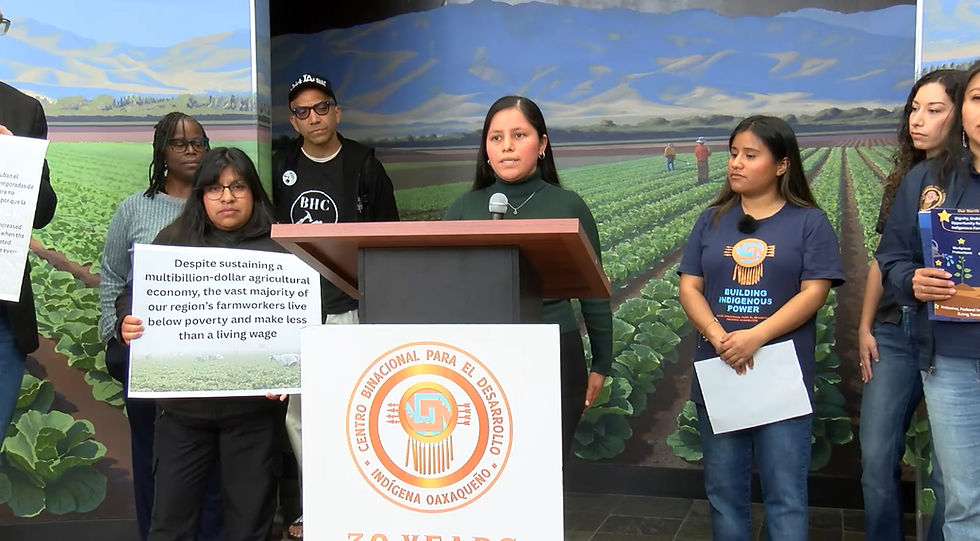
At this event, we featured Maria M., a worker from the Chatino community, who shared her personal testimony, highlighting the various injustices and inequalities faced by farmworkers. These conditions included unfair and dangerous work environments, wage theft, labor exploitation, and the constant fear of ICE raids. The Labor Justice team helped prepare Maria to share her story. Although she was initially hesitant, after a few minutes of conversation, we agreed that the situations she was experiencing were not as normal as she had thought, and that's when she became more motivated.
"If I don't say anything, the injustices will never end and they will continue to treat us however they please."
- Maria M
Maria recounted her personal experiences, describing the abuses she has suffered over the years while working in the fields of California. Her testimony highlighted how these problems affect the entire farmworker community, who are the foundation of a multi-billion dollar agricultural economy that feeds millions of people.
The report can be found here: https://transform.ucsc.edu/publication/dignity-in-the-fields/.
Mothers Talking and Healing
By Nicolasa Rodriguez and Alejandra Campos
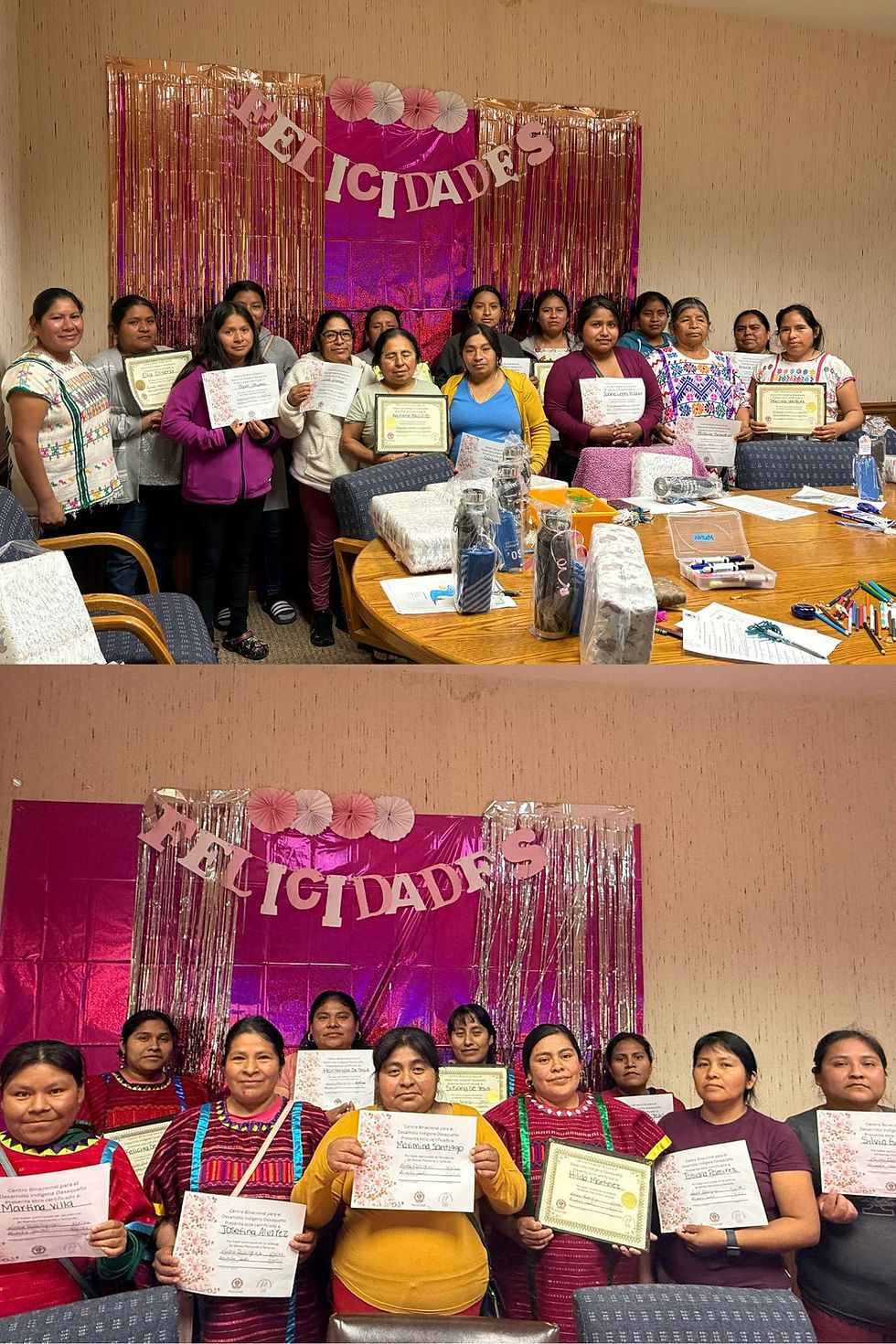
Celebrating Our Healing Journey
Greenfield, CA - During the month of March, a very meaningful time of celebration was shared with Triqui and Mixteco mothers. It was a season filled with learning, reflection, and deep emotions, focused on the understanding and prioritization of emotional well being. Throughout this period, many participants experienced significant benefits in healing and growth.
One case that stands out is that of a Triqui mother who shared that she had been experiencing anxiety and stress in her daily life for a very long time without fully understanding what was happening to her. It was not until she began participating in the sessions that she began to notice important changes. She shared that learning how to manage negative thoughts helped improve her quality of life: she is now able to sleep and eat better, and she feels more alive. Even though she participated for a limited time, she applied the provided activities in her daily life, which also improved her physical health. She mentioned that her migraines have decreased significantly and that she is now able to cope with situations that previously felt overwhelming. Many of her symptoms have improved, and what she once thought was an illness, she now understands was related to her emotional health. She expressed deep gratitude for the program and for the facilitator, who provided a safe space especially in her own language where she could express herself with confidence.
Another notable case is that of a young Mixtec mother who did not understand the emotional changes she experienced during pregnancy and after giving birth. These emotional shifts became frequent in her daily life, making her feel unable to carry out many of her responsibilities at home. As a mother, she did not feel comfortable talking to anyone about her emotions due to feelings of shame and fear of being judged, so she chose to remain silent.
However, after joining the mothers’ group, she found a safe space where, through examples like “Violeta” and “María" (mentioned above), she was able to recognize that what she was experiencing was related to depression. Because the topics were explained in her language, she was able to better understand her emotions and felt safe enough to express herself. This process allowed her to acknowledge her feelings and begin her journey toward emotional well-being.
Bringing Health Care to Huron Farm Workers
By Ana Arenas & Teresa Morales

Fresno, CA - On the afternoon of March 17th, CBDIO partnered with University of California, San Francisco (UCSF) providers to bring a mobile health clinic to Huron, CA. We set up in a familiar place for farmworkers, the parking lot of Panadería de Dios. As farmworkers began arriving with lunch bags still in hand, many stopped by this familiar gathering spot on their way home. The CBDIO team greeted them warmly, inviting them into a space that felt safe, easy, and at a time that works best for them. Many received a health screening and health education with no need for appointments. We and UCSF were able to provide health access to them right at the corner of their homes.
Over the course of the afternoon, 36 community members were seen by the medical providers on site. Each person received a health screening, with some accessing additional care on the spot. One community member received an iron check, another was able to refill a needed medication, and two left with new prescriptions in hand. For five community members, medications were provided right then and there at the clinic site, and one person received a flu shot, a small but important step in protecting their health.
For many community members in Huron, access to healthcare is shaped by challenges like lack of health insurance, transportation, identification, or unstable mailing addresses, along with demanding work schedules. The trust CBDIO has built over time with farmworkers was evident in the turnout and the openness of those who participated. Community members shared that providers were attentive, and many expressed appreciation for an environment that felt welcoming and respectful to their work times, making it easier to access health services.
VeꞋe TùꞋun program at McKinnon McKinnon and Santa Rita Elementary
By Daniela Maldonado

Salinas, CA - March was filled with joy and recreational activities in the Vè'e Tù'un after-school program at McKinnon. On March 6, the first cultural event took place, which was the Carnaval celebration at Santa Rita Elementary School. The excitement and happiness of the parents were evident as they watched their children perform a dance. Before the event, the students were very nervous, as it was their first time participating in this type of performance. However, once on stage, they showed great confidence as if they had done it many times before. The performance was incredible and received many compliments.
During the same month, students began working on their painting, which will be gifts for Mother’s Day. The results were beautiful, and the students are excited to give their art piece to their moms. Everyone was able to complete their paintings before the start of spring break. Additionally, the month focused on individualized support to help students strengthen their skills in mathematics, writing, and reading, which are the areas where they face some challenges. The program also welcomed Harmony at Home, who delivered a presentation about emotions. During this activity, students shared their feelings and reflected on how negative words can affect others. Overall, March was a short but very productive month within the Vè'e Tù'un program.
Carnival 2026
By Abigail Martinez
“Our Traditions: A Bridge to Visibility”
One of the objectives of our program is to bring Mixteco culture into the spotlight—a culture that many children know only through videos or the stories told by their parents. Thanks to the creativity of our team, the support of parents, and the participation of students from Ve’e Tù’un, we were able to experience the carnival firsthand. Although this is not the first time we have celebrated this event, this edition was special: the majority of the students participated in activities that demonstrated that our traditions are not static; as Mixtecs, these traditions are etched into our very identity, and we share them with pride.
It was a deeply moving gathering that brought together parents, teachers from Santa Rita and McKinnon elementary schools, RAS staff, as well as members of the Salinas City Council. An entire community came together to share traditional food, dance, music, and—above all—a sense of belonging and inclusion. The children enjoyed themselves alongside their families and teachers in a space where they felt "at home" and confident enough to showcase their rich cultural heritage.
*Tequio* is one of the fundamental values of our Mixtec culture. As a testament to this, many families contributed traditional dishes—such as *mole*, *tamales*, *atole de grano*, and *memelas*—allowing some 180 people to share in the flavors of our region. For the community, enjoying these dishes so far from home was an extraordinary experience. This event serves not only as a bridge between generations but also as a vital space for giving visibility to the Mixtec presence within the school environment.
Statewide Reach

*Español
El camino colectivo de los trabajadores agrícolas hacia la fortaleza y la unidad
Boletín mensual - Marzo 2026
Primera Asamblea Indígena de Trabajadores del Campo 2026
Escrito por Carmela Ramírez y Fidelina Espinoza
Madera, CA - La primera asamblea de trabajadores agrícolas marcó el inicio de un camino de resistencia y solidaridad que da fuerza a los trabajadores para mantenerse unidos y empoderados. El programa de Justicia Laboral y Justicia Económica fue testigo de que, con esfuerzo y organización, se pueden lograr grandes cosas. Nos llena de orgullo compartir que más de 180 trabajadores del Valle Central y la Costa Central formaron parte de esta primera asamblea, dando el primer paso hacia nuevas visiones y acciones colectivas.
Los comités de trabajadores mostraron su alto compromiso y liderazgo al viajar desde Monterey, Tulare, Fresno y Madera para ser parte de la primera asamblea. La asamblea comenzó con bienvenidas en lenguas indígenas, honrando nuestras raíces, identidad y cultura. Líderes de cada región compartieron palabras en sus lenguas maternas, rompiendo barreras y creando un espacio de confianza, respeto y pertenencia. Escuchar nuestras lenguas maternas vivas llenó el espacio de orgullo, fuerza y empoderamiento.
También se presentaron las campañas, sobre las cuales los trabajadores ya habían votado previamente, y varias personas expresaron su acuerdo con el compromiso y la participación necesarios para lograrlas. Líderes de cada región destacaron los logros alcanzados en sus comunidades.
El propósito del encuentro fue que los comités del Valle Central y la Costa Central se conocieran, identificaran luchas y experiencias compartidas, y reafirmaran su poder colectivo, lo cual se logró. Se pudo ver el compromiso, el liderazgo y el tequio de los líderes durante la asamblea. Aunque venimos de distintos condados, nos une la misma lucha, la misma esperanza y el mismo compromiso por un futuro más justo.
LDignidad en el campo: dando voz a los trabajadores agrícolas del Valle de Salinas
Escrito por Sergio Cruz Lopez y Yesica Guzman Rodriguez
Salinas, CA - Este Marzo 12, 2026, el equipo de Justicia Laboral organizó una rueda de prensa donde se presentó por primera vez el reporte “Dignidad en el campo: garantizar el bienestar y la prosperidad de los trabajadores agrícolas latinos e indígenas en el Valle de Salinas”. Este reporte fue un esfuerzo colaborativo entre CBDIO y el Instituto para Transformación Social de UC Santa Cruz. En este reporte se destaca la inequidad que existe para la comunidad campesina. A lo largo del informe se destacan las voces y experiencias de los trabajadores agrícolas del Valle de Salinas. A pesar de ser la fuerza laboral principal siguen siendo los más ignorados, permaneciendo prácticamente invisibles. Estos trabajadores contribuyen a una economía agrícola competitiva a nivel mundial; sin embargo, sus propios ingresos no son suficientes para satisfacer sus necesidades básicas de una vida digna, seguridad y salud básica. El informe también ofrece soluciones para abordar los problemas que afectan a la comunidad de trabajadores agrícolas.
En este evento, presentamos a Maria M., una trabajadora de la comunidad Chatina, para que compartiera su testimonio personal, exponiendo las diversas injusticias y desigualdades que enfrentan los trabajadores del campo. Estas condiciones incluyen entornos laborales injustos y peligrosos, robos de salario, explotación laboral y el temor constante a redadas de ICE. El equipo de Justicia Laboral ayudó a preparar a Maria para compartir su historia. Aunque al principio ella tenía dudas, después de unos pocos minutos de conversación concordamos que estas situaciones que ella estaba pasando no era tan normal como ella lo pensaba, fue cuando ella se vio más motivada.
“Si yo no digo nada, las injusticias nunca acabarán y van a seguir tratandonos de la forma que a ellos les plazca.”
- Maria M
Maria narró sus experiencias personales, describiendo los abusos que ha sufrido a lo largo de los años mientras trabajaba en el campo en California. En su testimonio, se destacó cómo estos problemas afectan a toda la comunidad trabajadora del campo, quienes son la base de una economía agrícola multimillonaria que alimenta a millones de personas.
El reporte puede ser encontrado aqui: https://transform.ucsc.edu/publication/dignity-in-the-fields/.
Mamas Platicando y Sanando
Escrito por Nicolasa Rodriguez y Alejandra Campos
Celebrando Nuestro Camino de Sanación
Greenfield, CA - Durante el mes de marzo se vivió una etapa muy significativa de celebración junto con las mamás Triquis y Mixtecas. Fue una temporada llena de aprendizaje, reflexión y emociones profundas, enfocadas en el entendimiento y la importancia de la salud emocional. A lo largo de este periodo, se fortaleció un espacio de sanación y crecimiento a través del programa Mamás Platicando y Sanando, donde muchas participantes lograron beneficiarse de manera notable.
Un caso que resalta es el de una mamá de la comunidad Triqui, quien compartió que durante mucho tiempo había experimentado ansiedad y estrés en su vida diaria, sin entender exactamente qué le sucedía. Fue hasta que comenzó a participar en las sesiones iniciando desde la sesión 3 que empezó a notar cambios importantes. Comentó que aprender a manejar los pensamientos negativos le permitió mejorar su calidad de vida: ahora puede dormir y comer mejor, y se siente más viva. A pesar de haber participado por un tiempo limitado, aplicó las actividades aprendidas en su vida diaria, lo que también contribuyó a mejorar su salud física. Incluso mencionó que sus migrañas han disminuido considerablemente y que ahora puede enfrentar situaciones que antes le resultaban muy difíciles. Muchos de sus síntomas han mejorado, y lo que antes pensaba que era una enfermedad, ahora entiende que estaba relacionado con su salud emocional. Expresó un profundo agradecimiento hacia el programa y hacia la facilitadora por brindar un espacio seguro, especialmente en su idioma, donde pudo expresarse con confianza.
Otro caso especial es el de una joven madre de la comunidad Mixteca, quien no comprendía los cambios emocionales que experimentaba durante su embarazo y después del parto. Estas emociones se volvieron frecuentes en su vida diaria, lo que le hacía sentir incapaz de realizar muchas de sus actividades en el hogar. Además, no se sentía con la confianza de hablar con alguien sobre lo que estaba viviendo, debido a la vergüenza y al miedo de ser juzgada, por lo que prefería guardar silencio.
Sin embargo, al integrarse al grupo de mamás, encontró un espacio seguro donde, a través de ejemplos como los de “Violeta” y “María”, pudo identificar que lo que estaba experimentando estaba relacionado con la depresión. Gracias a que los temas fueron explicados en su idioma, logró comprender mejor sus emociones y se sintió con la confianza de expresarse. Este proceso le permitió reconocer sus sentimientos y comenzar su camino hacia el bienestar emocional.
Llevando Atención Médica a los Trabajadores del Campo de Huron
Escrito por Ana Arenas y Teresa Morales
Fresno, CA - En la tarde del 17 de marzo, CBDIO organizó un evento con University of California, San Francisco (UCSF) para llevar una clínica de salud móvil a Huron, la cual se llevó a cabo en un espacio familiar y conveniente para la comunidad, el estacionamiento de la Panadería de Dios en Huron. El horario fue intencional, por la tarde, cuando los trabajadores del campo comenzaban a llegar con sus loncheras aún en mano, deteniéndose en el estacionamiento de la Panadería de Dios en su camino a casa. El equipo de CBDIO los recibió con amabilidad, invitándolos a un espacio que se sentía seguro, accesible y en su propio tiempo para recibir exámenes y educación de salud. El evento fue organizado para ellos, sin necesidad de citas, trayendo atención médica disponible justo en la esquina cercana de sus casas.
A lo largo de la tarde, 36 miembros de la comunidad fueron atendidos por el personal médico presente de UCSF. Cada persona recibió un examen de salud, y algunos accedieron a servicios adicionales en el momento. Un miembro de la comunidad recibió una prueba de hierro, otro pudo recibir un relleno de medicina, y dos personas se fueron con nuevas recetas médicas. Además, cinco miembros de la comunidad recibieron medicamentos en el mismo lugar, y una persona recibió la vacuna contra la gripe, un paso pequeño pero importante para proteger su salud.
Para muchos miembros de la comunidad en Huron, el acceso a la atención médica está limitada por desafíos como la falta de cobertura médica, transporte, identificación o direcciones postales inestables, además de horarios de trabajo exigentes. La confianza que CBDIO ha construido con el tiempo en la comunidad de Huron fue evidente en la participación de la comunidad en este evento. Los miembros de la comunidad compartieron que los proveedores fueron atentos y muchos expresaron su agradecimiento por el evento de clínica de salud el cual fue planeado para llegar a ellos y disminuir barreras, lo que facilitó dar el paso para recibir atención médica.
Programa Vè'e Tù'un después de escuela de Santa Rita y Mckinnon
Escrito por Daniela Maldonado
Salinas, CA - Marzo estuvo lleno de alegría y actividades recreativas en el programa Vè'e Tù'un después de la escuela en McKinnon. El 6 de marzo se llevó a cabo el primer evento cultural que fue la celebración del carnaval en la escuela Santa Rita. Se destacó la emoción y alegría de los padres al ver a sus hijos presentar un baile. Antes del evento, los estudiantes se encontraban muy nerviosos, ya que era la primera vez que participaban en una presentación de este tipo. Sin embargo, al estar en el escenario demostraron gran seguridad como si lo hubieran hecho en múltiples ocasiones. La presentación fue increíble y recibieron numerosos elogios.
Durante el mismo mes, los estudiantes comenzaron a trabajar en sus pinturas, las cuales serán un regalo para el día de las madres. Los resultados fueron hermosos, y los estudiantes se muestran entusiasmados por entregarlos. Todos lograron terminar sus pinturas antes de iniciar las vacaciones de primavera.
Asimismo, el mes se enfocó en el trabajo individual con los estudiantes para fortalecer sus habilidades en matemáticas, escritura y lectura. Son áreas en las que presentan algunos desafíos.
El programa también contó con la participación de Harmony at Home, quienes ofrecieron una presentación sobre las emociones. Durante esta actividad, los estudiantes compartieron sus sentimientos y reflexionaron sobre cómo las palabras negativas pueden afectar a los demás. En general, marzo fue un mes corto pero muy productivo dentro del programa Vè'e Tù'un.
Carnaval 2026
Escrito por Abigail Martinez
“Nuestras tradiciones: Un puente hacia la visibilidad”
Uno de los objetivos de nuestro programa es visibilizar la cultura mixteca, la cual muchos niños conocen solo a través de videos o relatos de sus padres. Gracias a la creatividad de nuestro equipo, el apoyo de los padres y la participación de los estudiantes de Ve’e Tù’un se pudo vivir la experiencia del carnaval en persona. Aunque no es la primera vez que celebramos este evento, esta edición fue especial: la mayoría de los alumnos participaron en actividades que demostraron que nuestras tradiciones no son estáticas; como mixtecos, las llevamos tatuadas en nuestra identidad y las compartimos con orgullo.
Fue un encuentro profundamente emotivo que reunió a padres de familia, profesores de las primarias Santa Rita y McKinnon, personal de RAS e integrantes del Council de Salinas. Toda una comunidad se unió para compartir comida tradicional, danza, música y, sobre todo, un sentido de pertenencia e inclusión. Los niños disfrutaron junto a sus familias y maestros en un espacio donde se sintieron "en casa" y con la confianza de mostrar su riqueza cultural.
El tequio es uno de los valores fundamentales de nuestra cultura mixteca. Como muestra de ello, muchas familias aportaron platillos típicos como mole, tamales, atole de grano y memelas, permitiendo que unas 180 personas compartieran el sabor de nuestra región. Para la comunidad, disfrutar estos platillos lejos de casa fue una experiencia extraordinaria. Este evento no solo es un puente generacional, sino un espacio vital para dar visibilidad a la presencia mixteca en el entorno escolar.
Alcance estatal


Comments